

Most employee engagement activities don’t actually engage employees — and the research to prove it is damning. Gallup’s 2026 State of the Global Workplace Report found that global workforce engagement fell to its lowest level since 2020. This trend cost the world economy an estimated $10 trillion in lost productivity last year.
U.S. engagement sits at just 31% — meaning nearly seven out of ten American workers are either checked out or actively working against their employer’s interests. By the way, companies aren’t ignoring this disengaged employees problem. On the contrary, they are spending significant money trying to improve employee satisfaction and boost morale. But many of these well-meaning employee engagement ideas may actually be hurting your company culture.
For instance, one “solution” is the company-wide mandatory giving day. The company pulls every employee from their desk to “voluntold” on a charity project. (Whether they want to be there or not.)
Or, in the softer version, an executive invites team members to “volunteer” for a charity giveback or service project during the workday. This puts employees in an uncomfortable position where they either abandon their work responsibilities or become the one who visibly didn’t participate in one of the charity events.
You can’t boost engagement by forcing team members to do extra work. And beyond that, there is a practical reason that rarely gets said out loud. When employees leave their desks for an employee engagement initiative, productivity goes down, not up. That cost is real.
A better solution exists, though. It just requires understanding the difference between a corporate volunteer day, a CSR activity, and a well-designed charity team-building event. These three things look very similar from the outside, but each produces a completely different type of workforce engagement.
There Is a Big Difference Between a CSR Volunteer Activity and a Well-Designed Charity Team Building Activity.
In this post, I’m going to focus on the different types of employee engagement ideas that involve charity donations or charity events. That’s my expertise, so I’ll share a few examples of these workforce engagement initiatives that worked really well and a few that missed the mark entirely. Just as background, let’s cover the most common types of charity team activities that companies organize for their team members.
A Well-Designed Charity Team-Building Activity.

Back in 2005, an event planner in Dallas, TX, had heard about how fun and interactive my leadership classes were. She told me that her client wanted a charity activity of some kind but needed it to be educational so she could get the budget approved.
Our first thought was to have the group build something for the charity — maybe bicycles for little kids. But we had two HUGE problems. First, building bikes isn’t much fun. And second, assembling a bike is pretty easy. It would only take a couple of people a few minutes to assemble it.
One of my instructors had previously hosted a sales meeting where she gave the group cardboard, a few pieces of Styrofoam, and some other items and had them build a boat. She made it a little friendly competition. The first team to build a boat that could support the weight of a teammate long enough to cross the hotel pool would be declared the winner.
She said that the building of the boat became secondary. It was the team problem-solving — all working together — that made the activity really fun.
So we used the same philosophy for the very first Build-A-Bike® activity. We organized the big group into smaller teams. And, we made it appear as though each team was competing against the other. These teams had to work together to solve a series of team challenges. After each success, they received a new bike part.
What they didn’t know, though, was that each team had information that other groups didn’t have. When they interacted with the other teams, the solutions became obvious. It was fun and challenging. And even if someone in the group didn’t turn a single wrench, they still felt like they were a part of the outcome.
CSR Volunteer Activity.

Corporate Social Responsibility (CSR) activities became popular in the early 2010s. Salesforce, Unilever, and Patagonia were a few of the early adopters who used these initiatives to create a more positive workplace culture. For example, Salesforce created a 1-1-1 philanthropic model. According to their website, Salesforce “committed to giving back 1% of our time, equity, and product to our communities, pioneering the Pledge 1% model.”
By the mid-2010s, companies were creating entire CSR departments with CSR budgets. That’s when a few unintended consequences began to occur. CSR departments had to use their budgets and show results. The problem was that the results they were measuring had nothing to do with employee engagement. They were measuring dollars donated, volunteer hours logged, and press coverage generated. Those are marketing metrics, not morale metrics.
Back in the 2010s, JPMorgan Chase (JPMC) created a corporate volunteer program called Goodworks. Team members who had full-time jobs at the bank organized these initiatives on a volunteer basis. It started as a Win-Win-Win for the organization.
For instance, in 2018, 150 JPMC team members flew into New York for an annual meeting. They added a Build-A-Bike® activity as the final hour of the three-day meeting, and GoodWorks paid for it. The group improved teamwork, JPMC received great PR and improved morale, and dozens of local kids received new bicycles. Everybody won.
A few years later, GoodWorks adopted a CSR-focused approach. Instead of adding CSR activities to already scheduled meetings, they divvied up the budget to each volunteer leader. These poor volunteers had no experience organizing CSR activities, and the program required them to use the funds before year-end.
Some locations had great results. But most locations expected hundreds of employees to participate, yet ended up with only a handful of volunteers. It was a huge missed opportunity.
A Corporate Volunteer Day or Day of Giving.

We started seeing Day-of-Giving activities pop up in the mid-2010s as well. Medium-sized companies with 1000 to 5000 employees typically organize them. Executives would see press releases from larger companies about CSR activities and want to organize something similar.
But since they don’t have a full-time CSR staff or budget, they typically just organize a single day of CSR activities. This sounds like a great idea, doesn’t it? Give your entire team a day to just give back to the community.
The first time I saw one of these was in 2014. A marketing firm was officed on three floors of a 10-story building. They had a check-in station on one of the floors where they gave away T-shirts, water bottles, and other trinkets. On another floor, one of my instructors led a teddy bear stuffing activity. And on the third floor, they had a different activity led by a different outside vendor.
They also had food stations, drink stations, and other tradeshow-type stations throughout the building. I’d guess that 30 to 50 of their staff had spent weeks organizing and all day manning all these stations.
But the major challenge was that the company scheduled this during a normal workday. So, team members grabbed a frou-frou mug of vanilla latte as they went to work. Then, popped out from time to time to grab a snack or get a free item. The volunteer charity builds were well attended, but the participants were distracted. They had been sitting at their desks ten minutes before the activity and were back at their desks ten minutes after.
So there was never a crescendo built into the activity or the day. It was fun, but I’d wager most people just thought the day was a distraction.
3 Reasons Why Your Employee Engagement Activities May be Reducing Employee Morale.
You’ve probably figured out by now, that I’m a big fan of charity team building activities and not so much a fan of CSR activities or give-back days. But I didn’t come by that opinion without merit. It’s from seeing and experiencing different types of charity activities over the years. Some are crowd pleasers. People are laughing, loving the time spent with coworkers, and high-fiving each other. While others are forced, uncomfortable, and… for lack of a better word… icky.
So, before you organize a charity activity for your company or team, realize the following…
1) Manual Labor Is Not Fun.

Think about a time you went to Ikea and came home with a piece of furniture in a box. My guess would be that your first thought when you got home was probably not, “Oh my gosh, I cannot wait to put that thing together!” Or maybe you were in your living room on Christmas Eve looking at a some-assembly-required box and thinking, “That is going to be so much fun!”
Companies spend enormous amounts of money every year inserting manual labor activities into meeting agendas, thinking the hard work will make the meeting more fun. The work, though, isn’t really collaborative. Yeah, your team members may chit-chat with each other while they work. But they won’t be learning anything about each other or developing teamwork.
A woman called us from a company that wanted to hire us to supervise a bike build during breakfast at their annual meeting.
She explained that they do a service project every year, and “Our team members absolutely love them!” Since their agenda was jam-packed, the only time available was during breakfast on the last day of the convention. She realized it was an odd time, but didn’t want the team to miss out on the fun.
We understood the impulse completely. She wanted to do something meaningful for her team and for the community. That’s the right instinct. But think about what she was actually asking her employees to do. She wanted them to show up on the last morning of a multi-day conference and assemble bicycles with their hands while sitting at a banquet table with bacon and eggs.
She’s not alone. We get calls every week from folks saying they don’t want to do a team activity. They just want to build bikes. They’re missing what makes Build-A-Bike® so fun.
 2) Most Employee Engagement Activities Appear to Work Because the People Running Them Are Measuring the Wrong Thing.
 2) Most Employee Engagement Activities Appear to Work Because the People Running Them Are Measuring the Wrong Thing.
Think about the last workforce engagement activity your company ran. How do you know it worked?
Most organizations just compare this year’s activity to last year’s. We have 300 employees in our building. Out of the 300 employees, 60 of them RSVPed (20%). Of those, 30 participated, which is 10 more than last year. That’s a 50% increase! All 27 attendees at the end said, “It was fun. Let’s do it again.”(It was 27 because three people had commitments that they couldn’t reschedule, so they had to leave a little early.)
The problem is that attendance measures nothing except attendance. Employees show up to company events for all kinds of reasons unrelated to engagement — free food, social pressure, a manager who notices who’s missing. Showing up is not engaging.
The Society for Human Resource Management put it plainly in a recent guide, “Without measuring whether collaboration actually improved, employee engagement activities become symbolic rather than strategic.” That is exactly what most companies are running — symbolic activities with no measurement system to tell them whether anything actually changed.
Meanwhile, Gallup’s State of the Workforce Report found that global employee engagement fell to 21% in 2024 — the lowest since the pandemic — costing the global economy $438 billion in lost productivity. U.S. engagement specifically hit its lowest point in a decade, at 31%. Companies are not lacking for engagement activities. They are lacking for ones that actually work.
A better measuring stick has two marks on it. First, did employees participate because they wanted to, or because they felt they had to? And second, did anything change about how people interact on Monday morning? If you can’t answer yes to both, your employee engagement activity probably didn’t engage your employees effectively.
3) A Single Well-Designed Workforce Engagement Activity Outperforms a Bunch of Mediocre Ones.

Many organizers of employee engagement activities mistakenly think that more is better. I mean, if a little bit of community involvement is good, then more is better, and too much is just enough. This good-heartedness is actually a trap that can backfire, causing workforceengagement to drop.
Engagement is not built by volume. It is built on shared experiences worth remembering. Think about the best team you were ever a part of. What made it great? It almost certainly wasn’t the number of events you attended together. It was something you went through together — a hard project, a shared win, a moment where the whole team had to pull in the same direction and did.
We had a client hire us to do two different charity team-building activities in two different rooms at the same time. That’s an odd request, but we assumed it was because the hotel only had limited ballroom space. When we arrived at the venue, though, we realized that the company had 500 attendees. They had organized ten different 50-person activities in ten different rooms — at the same time.
What a missed opportunity. That company could have had all 500 people interacting, having fun, and high-fiving each other toward a common, huge donation. But instead, they created a disjointed series of unconnected activities.
I mentioned earlier how when we deliver a Build-A-Bike® activity, the teams think it is a competition. They silo up to beat the other teams. But when they realize they need the other teams to succeed, it breaks the silos. They begin to see the entire room as one cohesive team.
The 100 people we worked with in our two rooms got to experience that. The remaining 400 people got to “do good” for less than an hour.
Charity Team Building Activities Do Improve Employee Engagement.
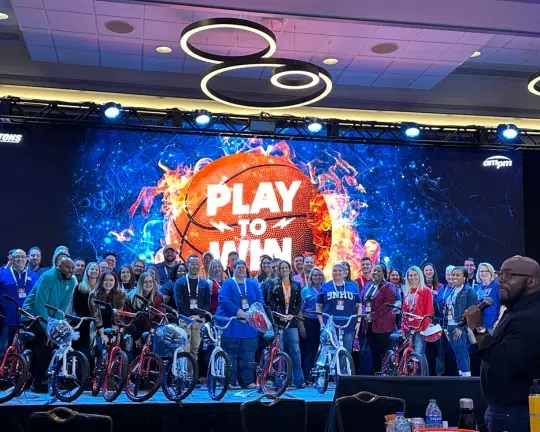
The best way to schedule a fun charity activity is to insert it into your regular meetings. Stand-alone CSR activities can be hit-or-miss. But if your team already has an annual meeting, conference, or convention scheduled, it’s a good idea to add something fun and team-oriented to that agenda anyway. This is where charity team-building activities are ideal — they are absolutely the best workforce engagement activities ever created. Here’s why.
- The focus isn’t on the charity donation — that is the outcome. The focus is on building teamwork and having fun!
- There is a built-in “networking” mechanism. Remote teams interact with office teams. Different departments also interact with each other in a fun way.
- You can easily tie the activity to real business outcomes. (Problem-solving, critical thinking, goal-setting, communication skills.)
- It’s easy to combine these activities into an already scheduled part of the meeting, like a networking icebreaker, happy hour, or meeting wrap-up.
- The fun activities also break up a stoic meeting and insert some team spirit and energy.
But the major benefit of inserting a charity team-building activity into your regularly scheduled meeting is that it is an easy way to elicit 100% participation from your team. In fact, it is the only way we’ve found to get your entire team to work together, have a ton of fun, and then rave about the activity to you afterward!
Want to book a Charity Team Building Activity for your group? Just click the link or call us at (800) 872-7830.