
 The best way to boost team skills isn’t through boring lectures but through experiential learning that sticks. Traditional schools and traditional trainers often rely on passive methods, leaving employees forgetting 70% of the content within a day.
However, with a few simple changes to your teaching process, you can create a more hands-on experience for your team. You can transform your training sessions by using active engagement — turning lessons into practical learning through practical experience.
Below, we reveal why traditional training methods, like lectures, fail. We’ll also show you how developing new skills is the key to helping your team grow and increase productivity. And we’ll also cover five simple professional development strategies that will reinforce an attitude of lifelong learning in your team.
Just follow this strategy, and you’ll we’ll help you make training interactive, slash time spent in the classroom, and skyrocket results from your sessions. Dive in to unlock a hands-on approach that builds confident, skilled teams!
Lectures and Seminars Have Low Retention. So, You’ll Need to Repeat the Training Later.
 About 12 years ago, social media was still in its infancy. Businesses like mine were looking for ways to capitalize on this new medium. At the time, I was fascinated by all the new and trendy things coming out of Silicon Valley. So, I registered for a huge social media convention in Atlanta. I couldn’t wait for it. Speakers from dozens of trendy tech companies were on the agenda.
The first speaker took the stage and talked and talked and talked. Granted, it was probably great information, but I was bored to tears. Even so, I frantically took notes. But he covered so many different, unrelated aspects that it was difficult to put any of them into action.
The next speaker was a little better. She told a few real-life case studies. But, since she worked in a totally different industry (her company sold consumer products), her case studies didn’t really apply to me. I attended lecture after lecture for two days. I had a bunch of notes, but I had no way to apply the ideas in my industry.
Interestingly, during the happy hour at the end of the second day, I met another professional speaker from Phoenix. He and I chatted for about 20 minutes about different things we were doing with social media. That 20-minute chat was probably worth more to me than the entire other 15 hours or so of lectures.
Just by discussing the content with each other, we were creating an entirely different learning experience. The active engagement made the training more fun and useful.
Unfortunately, most corporate trainers make the same mistake that the organizers of the conference made. They focus on bombarding their employees with information without helping them apply the information in the “real world” using a hands-on approach.
Recent Studies Show that Hands-On Learning Has up to 10X the Value of Lecture.
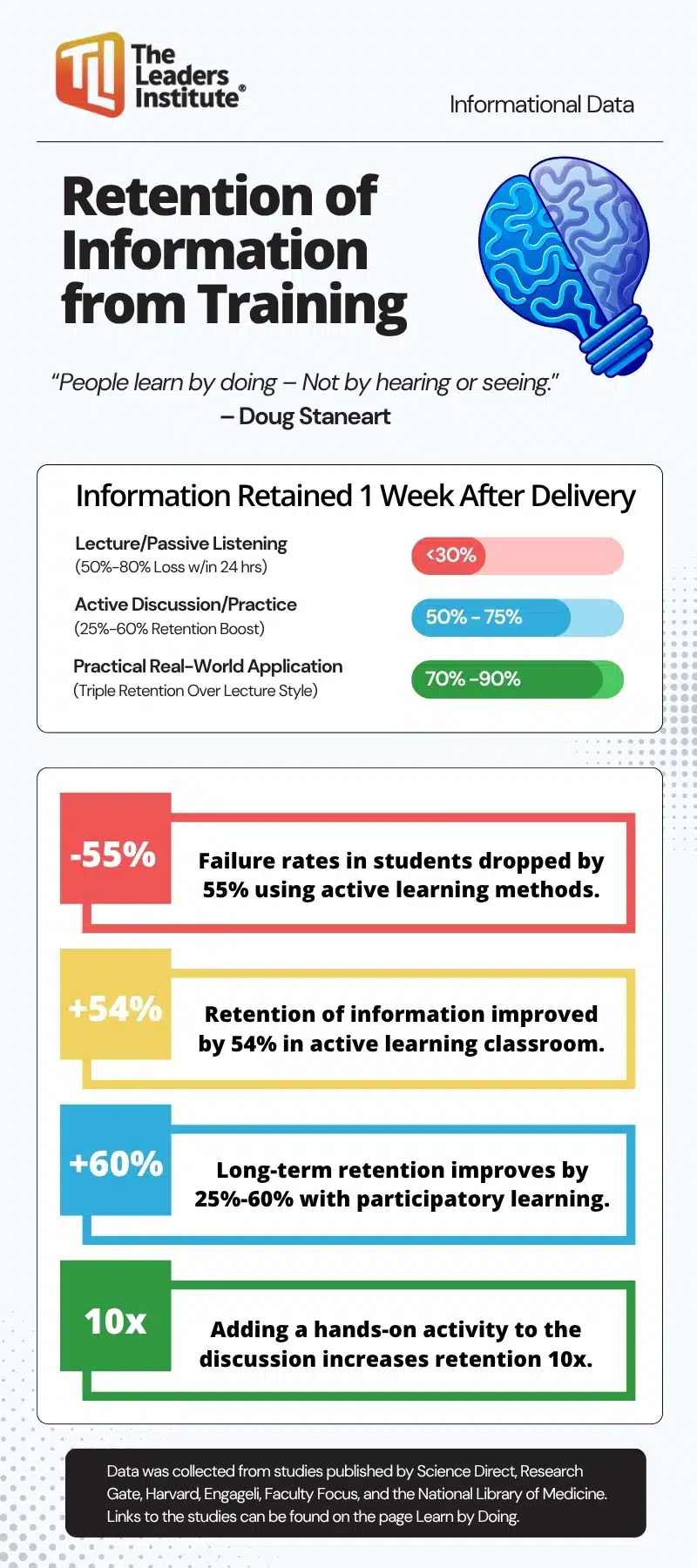 Let’s say that you deliver a training session verbally to your employees or team members. Studies show that within 24 hours, the participants will only remember about 30% of the content. They will have forgotten 70% of what you said. (National Library of Medicine, The Science Behind Learning Retention.)
What’s worse is that we’ve known about this problem for over a century. The concept of the “Forgetting Curve” was first introduced by German psychologist Herman Ebbinghaus in 1885. And modern studies have verified his results. (Univ. of Amsterdam 2015) So, using a lecture learning process, without reinforcement, the information received is forgotten very quickly.
However, just adding in a discussion with the group helps students retain up to 75% of the content. That means that if, sometime during the lecture, you stop and let the group discuss what they’ve heard with each other, they’ll remember up to 60% more than they would with a lecture alone.
And, if you add some type of reinforcing activity to your delivery, your students will retain up to 90% of it.
For instance, each of our one-hour leadership modules typically has this pattern. We start with 15 minutes of information, followed by a short group discussion. Then, we add 10-15 minutes of clarifying information. At the end, we have the group participate in a reinforcing activity.
An example of this is when I teach listening skills. I’ll start by giving the group information about the four levels of listening. Then, I ask the audience to help me create a comprehensive list of “bad listening habits.” Afterward, I verbally reinforce the list to clarify what was said. Then, I use experiential learning to gamify the content. The group partners up to start a conversation. But they have to listen at one of the lower levels.
People Learn by Doing — Not by Hearing or Seeing.
 This teaching concept works because people learn by doing — not by hearing or seeing. That short, funny activity at the end reinforces the theoretical content in a practical way. Instead of memorizing information about how to listen they discover what it feels like when someone looks at their phone while they are talking. That feeling sticks with them longer than a list of bullet points.
“If I hear, I forget. If I see, I remember. If I do, I understand.” — Confucius
When I taught my daughter how to ride a bicycle, I did what my dad did. I sat her down on the sofa, pulled out my PowerPoint slideshow, and showed her 60 slides about bicycle riding…
No, of course I didn’t do that. But that is what we do to our employees and coworkers when we train them.
What I really did was, instead of bombarding her with a bunch of unneeded content, I just gave her one piece of information: “Just keep pedaling and you won’t fall.” Then, I held the bicycle seat while she practiced. I used this hands-on approach for 15 minutes. Then we stopped.
A couple of days later, we practiced again. This time, I held the seat slightly less. After a week, she got more confident. Next, I taught her how to steer the bike by leaning slightly. Within a few weeks, she was more confident — her attitude had improved.
By the way, this learning process is very important. If you understand it, you can build confident leaders throughout your organization. If you’re familiar with the Cycle of Self-Development or the KSA Triangle, you’ll see that I applied these concepts in both the bicycle example and the Listening Session. We’ll cover that more in a future post.
Simple Ways to Make Your Training Interactive to Reduce Training Time and Increase Application of the Material.
So how do you make your training or lectures more interesting? Since people learn by doing, how do you get your team members to do something in your training?
Just remember that most learning experiences used in the business world are very passive. If you do what most trainers do, you won’t tap in to the learning process that really sticks. Instead, use a more hands-on approach. Change up your learning process to make them more engaging. Below are a few simple things that we find work very well.
1) Insert a Discussion After You Cover a Section of Content.
 Remember that (1) people learn by doing, (2) they have short attention spans, and (3) people like to hear their own voice. So, an easy way to break up a lecture and make it interactive is to just add a short discussion along the way.
An easy way to do this is with a technique called “think, write, share.” Ask the group a question. Then give them a chance to write down an answer. Once you know that most people wrote something down, have them share their notes with the person sitting next to them.
For instance, during a safety training session, you might stop and ask, “What kind of things might happen on a job site that would make following this rule more difficult?” Have them write down two or three answers. Then, have them discuss the answers with a partner.
Or, let’s say you are onboarding new employees. While teaching them the company’s values, you might say, “We make our hiring decisions based on how we think your personality and strengths align with these values. So, take a minute to write down what you think we saw in you that let us know you also have these values.”
This time, you could put the new hires into small groups and have them tell the group what they wrote. As each person verbalizes a few of those values, it will reinforce them over and over to the entire small group.
The main point here is to make your training sessions a dialogue versus a monologue. Get them to talk more and you talk less, and they’ll learn faster.
2) Small Group Discussion with Reporting.
 This next technique is a slightly different version of “think, write, share.” This time, you’d break the class into small groups of five to eight people. Then, ask them to come to a consensus on the answer to a question (or series of questions). Have them pick a group leader or spokesperson, give them a few minutes to discuss their ideas.
Then, have one person from each group give a short report of what their group came up with. This is a simple way to reinforce the content and get the participants to think more deeply about it.
We do this a lot toward the end of our training sessions as a debrief. For instance, when I teach about conflict resolution, I have the small groups identify at least couple of situations that happened recently where a conflict erupted. Then, I have them tell their groups how the content just presented would have helped in each situation.
As I mentioned before, this move the theoretical concepts into something more practical.
3) Give the Group a Demonstration and a Chance to Practice in the Classroom.
 Anytime you are teaching a new process (or technique), consider giving an example or demonstration yourself. Then, allow the group to get practice using the new process in a controlled environment.
For instance, in our public speaking classes, we teach the group how to write a speech. then, we give them a demonstration. And finally, we allow them to create one themselves. That way, we can coach them.
If you are demonstrating a new piece of software, let the group play with the software in the training room. That way, they will get more comfortable with it.
4) Audience Participation Questions.
Another way to reinforce your content is to collect the content from the experts in the room — the audience.
 I typically use this technique when I am training a highly educated audience. For example, I recently taught a presentation class for a Washington, DC law firm.
Everyone in the class was a professional arguer. I knew that if I just walked into the training room and tried to give them information, many would likely try to challenge me during the presentation.
So, I started a little differently. I inserted an “opinion-asking question” early in the session. I said, “A number of you are top litigators. Let me ask you… What characteristics do the absolute best litigators have that allow them to connect with juries better than other litigators?”
I paused to let them think. Then, very quickly, one of the guys, who was likely one of the strongest personalities in the room, raised his hand. He said, “The really good ones present with confidence and authority. They lead the jury.”
I wrote “Confidence and Authority” on a whiteboard in the room and said, “Absolutely. People judge our competence by the confidence we show. What another?”
One of the more senior women in the room said, “Yeah, but good litigators also create an emotional experience for the jury.”
Just as before, I wrote her words on the board and said, “Yes, there is a balance. Juries think logically and emotionally. What’s another?”
I continued until I had an extensive list. Then, I said, “Would you agree that the best litigators will have most, if not all, of these characteristics?” Heads around the room nodded. “Good, because this class was designed to strengthen these characteristics.”
I was able to get the strongest personalities on my side early on. You can too.
5) Add a Group Activity to Reinforce the Content.
 If you really want your teaching to stick, add an activity to your training program.
For instance, instead of just having your safety training class take a test at the end, you could make the test way more fun. You could put caution take around an area of the room full of safety hazards that you created. (Obviously, don’t let anyone in the area.)
Divide the group into small teams that race to turn in a list of all the safety violations in the area.
If you’re onboarding new team members, you might send them on a scavenger hunt around the office to help them acquaint themselves with the building.
Keep in mind that you don’t have to do an activity for everything that you cover in the training.
For example, I recently taught a group of managers how to coach and mentor their team better. I gave them seven solid principles that work in different situations. One of those principles was how to give their team members a compliment without it feeling awkward or being taken the wrong way.
We covered the first six principles in a quick, cursory fashion. Then, we spent the last 15 minutes of the session just having small groups use the technique to compliment each other so they got practice using the skill. It created a fun and emotional reinforcement to the workshop content.
Design Your Training Sessions So Your Teams Can Learn by Doing!
Good trainers know that lectures flop. They are boring and participants forget 70% of content very quickly. You can transform your training by using experiential learning to make skills stick. Gamify your sessions to tackle real challenges.
Look for opportunities to spark active engagement that turns lessons into learning experiences. Discussions, demos, and activities can help you drive retention up to 90%. Instead of just bombarding your team with tons of data and information, help them master critical thinking.
Remember that knowledge is not power. The application of knowledge is where power truly comes from.
And, by the way, if you need help creating content for your team or updating your training sessions, we have a team of instructors who would love to help! You can Contact Us by clicking here.