

Emotional intelligence in leaders throughout your organization can positively impact your bottom line. This type of skill development can also increase employee engagement and improve morale. The following will highlight the nuances of emotional intelligence in leaders. We do this in three ways. We identify its importance, explain how to regulate our emotions, and show how to anticipate and respond to others’ reactions.
- What Is Emotional Intelligence
- Emotional Intelligence in Leaders Will Improve Productivity and Employee Engagement
- The Bottom Line
What Is Emotional Intelligence?
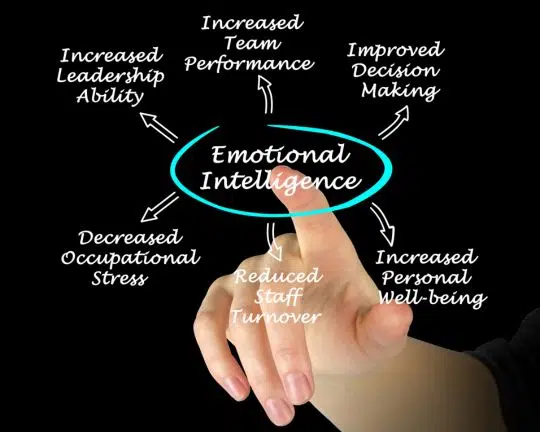
Emotional intelligence is the ability to manage your own reaction and read your team’s reaction well enough to get the result you want. That’s a little different than what you will find in a dictionary. In fact, most dictionaries define “emotion” in that way. But the concept doesn’t really have anything to do with emotions. Instead, it’s the skill level that a person has in dealing with other people.
And because the definition is a little vague, it can be difficult to see emotional intelligence as a definable trait in others. However, it is easy to spot its absence in someone. Especially when the lacking person is in a position of leadership.
This often happens with members of leadership. Unfortunately, while they have the IQ, for the workload, they lack the Emotional Quotient (EQ) to handle the team itself. This disconnect between IQ and EQ is the culprit for lack of morale, high turnover rates, and a lack of productivity.
Leaders Often Hire Based on Education or Experience. But If You Hire Based on EQ, You’ll Get Better Results.
Obviously, companies aren’t having applicants take an IQ test during the hiring process. But they may look at the degree that a person obtained. And they’ll definitely consider the applicant’s experience. However, it doesn’t matter how intelligent the applicant is or how much experience they have if they’re a nightmare to work with.
Just to be clear, this is not to say that a person’s qualifications or IQ don’t hold importance. However, it’s noteworthy that the ability to combine cerebral intelligence with emotional intelligence is what makes a great leader.
For instance, when we hire, we start with a standard virtual interview. Next, we interview the candidate in person. The real interview occurs, though, when the candidate tours our office and interacts with every member of the team. You see, we’re not just looking for new team members who can do the job. We also want people who will make us an even better team.
In the final stage of the hiring process, we’re evaluating the candidate’s EQ.
The Leader’s Emotional Intelligence Sets the Tone of the Workplace.
Leaders set the tone for a workplace. Without them driving a positive, emotionally regulated environment, not only will team morale suffer, but productivity will also be lower. In fact, a CareerBuilder survey of 2,662 U.S. hiring managers found that 71% valued emotional intelligence in an employee more than IQ. 75% said they were more likely to promote a candidate with high EQ over one with a high IQ but low EQ.
Emotional intelligence, or EQ, isn’t a soft skill to tack onto the end of a leadership workshop. It is the foundation everything else sits on. Here’s what I’ve learned about how EQ in leaders creates a genuinely positive workflow — and how you can start building it today.
Emotional Intelligence in Leaders Will Improve Productivity and Employee Engagement

The following five points will help bring awareness to your leadership teams on the impact they have on their employees. We will also focus on positive habits for leaders to better the workplace and bring balance to their lives overall. We will do this by focusing on skills that identify their emotional reactions, pick up on nonverbal cues from others, and implement positive, long-lasting habits in their daily lives.
1. Leaders Need to Be More Aware of the Impact They Have on Their Team Members
When I was in college, I got a part-time job at Sephora. Because of my past retail experiences, my mindset was that this job would last at most a year. To my surprise, I stayed for three years. I just couldn’t bring myself to leave the people, especially the management team. They made every person in the store feel seen, heard, and appreciated.
When I graduated college, I landed my first job at a startup news source. I thought this was the break I had been needing. Finally, a positive step towards the career I had been working so hard for. But unfortunately, my new leadership failed me.
At every turn, I was met with hostility and arrogance. My boss looked at me like a pawn to be moved around and nothing else. I left that position within two months. It was so strange. I stayed at a position that had nothing to do with my goals for three years. But the position that was supposed to take me towards my dream job wore down my spirit in a matter of weeks. This is the impact management has on a team.
This experience made me realize that the job never mattered as much as the way I was being treated. Every interaction you have with your team leaves a residue. Whether it’s your tone in a Slack message, your facial expression walking past someone’s desk, or your response to opposing opinions. None of that shows up on a performance review. But all of it shapes whether team members feel safe, respected, and motivated to do their best work.
2. Learning to Regulate Your Own Emotional State Promotes Positive Outcomes
We’ve all had those moments. Something happens, and without even realizing it, your chest tightens, your breathing becomes labored, and you can’t help but feel overwhelmed. All of a sudden you find yourself saying things you don’t mean, or lashing out at the first person you see. Now imagine if you took a real pause before responding to whatever triggered you. Even if that pause is just three breaths at your desk or a lap around the building.
I—like many others— used to think self-regulation meant swallowing my frustration and putting on a brave face. I don’t believe that anymore. I’ve learned that regulating my emotional state means acknowledging what I feel first. Then choosing my response instead of letting the emotion choose it for me. It seems tough in theory, but in principle it just means giving yourself 30 seconds to process your emotions before reacting.
None of this is about suppressing emotion. I think of it more like driving on a bumpy road. I stay aware of every bump, but I keep my hands steady on the wheel instead of swerving. My team doesn’t need a leader with no emotions. They need a leader who can manage their emotions without running their meeting off the road.
3. Understanding Others’ Emotional Maturity Provides Valuable Insights

Once I got a handle on my own emotional state, I started noticing something else. Not everyone on my team processes stress, feedback, or conflict the same way I do. Understanding where someone else falls on the emotional maturity spectrum is one of the most useful tools I have as a leader.
To do this, we need to focus on a few key traits, starting with actively listening. Oftentimes we may be listening to our team members, but we aren’t truly hearing them. Active listeners make eye contact, ask relevant questions, and note things down that could be helpful later. In short, they show that what the other person is saying holds value. Similarly, leaders need to be attuned to nonverbal cues. This includes things like facial expressions, fidgeting, even the tone and pace of someone’s voice. These small actions can help you decipher the state of mind and emotional level of the person you’re speaking with. This is even more relevant when making additions to your team.
I look for the same markers I’d want people to see in me. Accountability, openness to feedback, the ability to stay flexible when a plan changes, and empathy toward teammates. When I see the opposite — defensiveness, impulsiveness, an inability to let feedback land without taking it personally. I don’t write that person off. I adjust how I communicate with them. A single shift, reading someone’s emotional maturity before deciding how to deliver a message, prevents more conflict than almost anything else I do as a leader.
This isn’t just my own anecdotal read. Hiring practices have changed a lot over the years. When I’m building a team, I’m not just looking for technical skills anymore. I’m looking for emotional maturity. Because I’ve watched it predict how someone handles pressure and conflict far more reliably than a resume ever has.
4. Regardless of Personal EQ Growth, You Can’t Control the Emotional Responses of Others
This is the point I have to remind myself of the most, because it’s humbling. I can do everything right. Regulate my own state, read the room, communicate with empathy. But, unfortunately, someone on my team can still have a bad reaction. There’s no way for me to control that. I only get to control what I bring into the room.
The same goes for relationships. For example, if my significant other is processing the passing of a loved one. I can listen to them talk, sit with them while they grieve, and be supportive to the best of my ability. But I cannot make their grief go away. I can’t stop them from having bad days and lashing out sometimes. Everyone has bad moments— sometimes they happen at home, and sometimes they happen at the office. Regardless, it is not within our control to fix every single bad moment. Whether that be with our partners or our team members.
I’ve had to make peace with this. Leaders control many things at work, but there’s plenty we don’t. Someone else’s emotional response is squarely in that second category. Instead, I focus on what is within my control. My own tone, my own reactions, the boundaries I set, and the conditions I create for my team to succeed. I’ve also learned that my emotional state is contagious whether I intend it to be or not. My mood genuinely shapes the emotional climate of my team. At the end of the day, I can only control the energy I bring to the room. Not the reaction it brings.
Letting go of the need to control other people’s emotions has actually made me a calmer leader. I stopped taking other people’s bad days personally, and I stopped treating every negative reaction as evidence that I’d failed. Sometimes people are just having a hard day, and that has nothing to do with me.
5. Practice Positive Habits to Increase Emotional Intelligence

I don’t believe emotional intelligence is something you either have or you don’t. I believe it’s a set of habits, and like any habit, it gets stronger with repetition. Here’s what I actually practice, and what I recommend to every leader who comes through one of my programs:
Journalling, even briefly, to build self-awareness about what I’m feeling and why. Checking in with my emotions at the start of the day instead of letting them ambush me later. Practicing active listening in every one-on-one — really listening, not just waiting for my turn to talk. Asking for feedback on how my communication lands with people, because I can’t see my own blind spots. Setting clear boundaries, so I’m not running on empty by the time my team needs me most. Lastly, I try to notice nonverbal cues. The things people don’t say out loud but communicate anyway through body language and tone.
None of these habits are complicated. What makes them work is consistency. But it can be overwhelming to try and do them all at once. If you’re not sure where to start, pick one of these habits and practice it for two weeks before adding another. That’s the fastest way I know to see a real shift in how your team responds to you. You can always find more about EQ, communication, and team dynamics regularly on our blog. If you’re ready for structured practice instead of going it alone, our High Impact Leaders program is built around exactly this kind of habit-by-habit development.
The Bottom Line
I’ve watched emotional intelligence do more for a team’s culture than any org chart redesign or perk program ever could. I’ve also felt the cost of a team without it. When we become more aware of our impact, regulate our own state, read the emotional maturity of the people around us, let go of trying to control their responses, and practice the habits that build EQ day after day, we create a workflow that people actually want to be part of. That kind of workflow doesn’t happen by accident — it’s built one habit, one interaction, one leader at a time.